1969
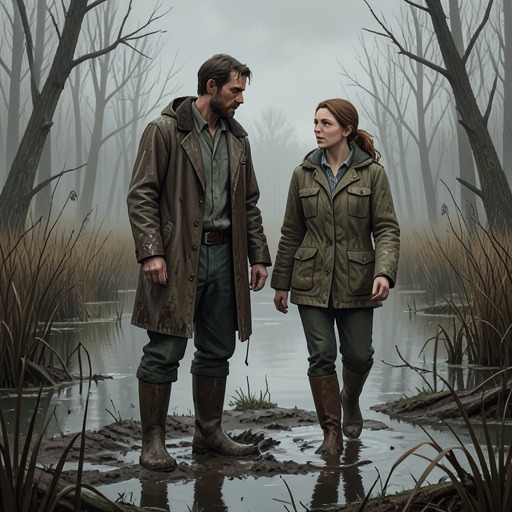
Norwegian Wood1969 is remembered by Toru Watanabe not as a year of decisive change but as a long, exhausting passage through a swamp. Its darkness and resistant mud give physical form to his isolation, while the routines that carry him through the year contrast with the transformations promised around him.
A Year Measured in Mud
Looking back on 1969, Toru sees himself trudging through a deep bog, each step threatening to pull off his shoe. The image makes time itself feel laborious: it moves in rhythm with his faltering progress, while the people around him have gone ahead. The swamp seems endless, and he cannot tell where he is or whether he is headed in the right direction. He knows only that he must keep moving, one step after another.
The year passes without a corresponding sense of personal renewal. Toru turns twenty and autumn gives way to winter, but nothing in his life changes significantly. The seasons register the passage of time; they do not release him from the bog.
Public Change and Private Stasis
The surrounding world appears poised for transformation. Toru recalls that John Coltrane had died and that people were calling for revolutionary change, imagined as just beyond the bend in the road. Yet the changes that arrived seemed to him like flat stage sets: backdrops without substance or meaning. The distance between public expectation and his own experience sharpens the year’s defining contrast. History speaks in the language of rupture, while his days remain a weary succession of steps.
His recollection is shaped by that contrast rather than by a catalogue of political events. The swamp does not simply represent private sadness; it is the image through which Toru renders a period in which collective promises of a new world fail to feel real to him. His account keeps the emphasis on the felt pace of time—slow, sticky, and difficult to distinguish from the effort of continuing.
Routine and Continuing Attachments
Toru’s daily life nonetheless has a clear pattern. He attends lectures without enthusiasm, works three nights a week at a record shop, and rereads The Great Gatsby from time to time. On Sundays he does his washing and writes a long letter to Naoko. These repeated tasks give the year a structure, but they do not amount to a cure or a turning point: the letters sustain contact while his sense of being stuck persists.
He sometimes goes out with Midori for a meal, to the zoo, or to the cinema. The Kobayashi Bookshop is sold as planned, and Midori and her sister move into a sunny two-bedroom flat near Myogadani, a more upmarket neighbourhood than their former home above the shop. Midori tells Toru she will eventually move out when her sister marries and rent a flat of her own. Her apparent enjoyment of the new home marks a change in her circumstances, set against Toru’s feeling that his own life has not changed in any significant way.
Withdrawal and the Year’s Unresolved Ending
Nagasawa occasionally suggests one of their outings, but Toru declines, finding the process more trouble than it is worth. He does not reject sex itself so much as the sequence of drinking, searching for women, talking, and going to a hotel. He admires Nagasawa’s ability to repeat that ritual, yet prefers the happiness he finds in thinking about Naoko to sex with an anonymous woman. The memory of Naoko’s fingers bringing him to climax in a grassy field remains vivid, making his attachment present even amid the year’s emotional inertia.
At the beginning of December, Toru writes to ask whether he may visit Naoko during the winter holidays. Reiko replies on Naoko’s behalf, explaining that Naoko is having trouble writing and that her difficulty comes in waves; she cautions Toru not to take it as proof that Naoko is especially unwell. The exchange gives his routine of Sunday letters a concrete consequence: his continuing connection with Naoko depends, for now, on Reiko’s answer. The year closes without the decisive transformation Toru has been waiting for, with movement reduced to the persistence of writing, remembering, and taking the next step through the swamp.